Katherine Frith likens reading adverts to peeling an onion. She pinpoints three stages to reading adverts:
- The surface meaning
- The advertiser’s intended meaning and
- The cultural meaning.
She concludes that ‘advertising only “makes sense” when it resonates with certain deeply held belief systems’ (Frith: 2006: 5).
We were asked to choose and ad and consider the following.
- a dominant reading
- an oppositional reading and
- a negotiated reading.
Post your chosen adverts to this forum with a short statement outlining why you interpret them in this way. Comment on the contributions and interpretations of your peers, addressing the following points:
- Do any common ‘belief systems’ emerge?
- Do any interpretations ‘blend and clash’?

The dominant theme in this ad is that the figure represents danger, the dark underpass, hooded youth with confrontational expression.
His posture appears to be challenging, threatening. The urban built environment with shuttered business in the background, the fact theres no one else around and the youth appears to be showing a weapon, most likely a handgun.
Then on closer examination the dominant theme subsides to that of a negotiated theme as it becomes apparent the hand gun is in fact a battery power drill. The eye finds the copy to the left which is incongruous tucked into the bottom left, the copy tells you that the youths future isnt inevitably one of crime where it may well be headed now.
With some life chances through education or training the weapon becomes the tools for a new direction, a trade maybe.
The ad is for an organisation called Always A Chance after James Cooper and James Kouzaris, two British tourists were tragically shot dead in Sarasota, Florida. 16 April 2011. It transpired their killer could have been somewhere completely different had a training opportunity come to fruition so the parents of the boys set up the charity to encourage young people who are outside full time education and employment to re-engage with the education system or support them as they take their first steps into employment.
So I think this is a great example of an ad that uses a dominant reading that then subsides into a negotiated reading upon closer examination.
An oppositional reading could be the ad reinforces stereotypes and exploits common belief systems that inner city youths are criminals, armed and from ethnic minorities.
I would counter that the ad successfully subverts that belief system and uses it in a positive way to engage a viewer educating them in the process that their assumptions were incorrect and even if the youth was heading for criminality its not too late to prevent it.
This weeks submissions from everyone were really interesting and so were the interpretations of the how the ads should read. This one in particular stood out to me and generated a very strong oppositional reading from myself..
Here is Clive Edwards post-

I’m not sure whether this image ever came out as an ad in its own right. Perhaps the video ad was pulled before the campaign got any commercial traction. The video ad for Pepsi achieved almost instant notoriety on its release in 2017. This is a still from the ad.
It features US mega celebrity Kendall Jenner. The narrative of the ad has her ‘gatecrashing’ a protest march. She throws off her blonde wig and joins the protestors as they march towards a line of armed police. Jenner, on reaching the police, pulls out a Pepsi and offers it to the stone-faced police officer, who accepts. Pepsi is therefore a symbol of harmony, unity and social cohesion.
That would have been the preferred reading of the Pepsi group and Creators League Studio who produced it. Jenner was chosen to front the ad because of her enormous appeal and influence as a fashion icon and social media celebrity.
There was an immediate backlash of oppositional readings, driven mainly by the #blacklivesmatter campaign, in which protestors were angered by police brutality particularly targeted at the black commmunity. Several memes and reconfigured versions of the original appeared on social media. Pepsi withdrew the ad very shortly after its release, following mounting criticism from the campaign.
This image below was tweeted with the caption: “Kendall, please give him a Pepsi”

Pepsi apologised to the campaigners, saying that they had “clearly missed the mark. We did not intend to make light of any serious issue.” They also apologised to Kendall Jenner for putting her in that position (their words).
So there was a preferred meaning, an oppositional reading… is there a negotiated reading? I’m not sure. Does Pepsi’s withdrawal of the ad suggest that both sides accept the oppositional reading, and that universal acceptance of its wrongness is the negotiated one?
I wonder also whether the Pepsi ad was badly mistimed. At another time, when anti-police protests were not high on the news agenda… would the ad have been , if not acceptable, then at least less unacceptable.
My response as follows-
The ad was monumental in its crass tone deafness, no timing would have been good for this affront to advertising and morality, two words you’ll rarely see in the same sentence.
The image of Jenner handing the can to the police officer was a clearly ‘inspired’ by the image of Ieshia Evans offering her hands for arrest to a group of riot-gear-clad police officers at the Baton Rouge Black Lives Matter protest literally weeks if not days before.
It in turn, the action, not the image per se, inspired by the iconic Bernie Boston shot of the young anti Vietnam war protester inserting a flower into the barrels of rifles pointed at the protestors during the “March on The Pentagon”, 21 October 1967.
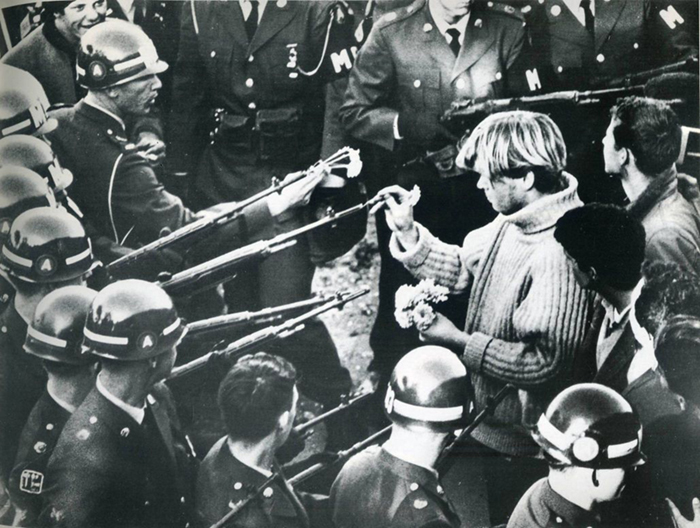
National Mall Protest, Flower Power, October 21, 1967. Photograph © Bernie Boston.
Any attempt to appropriate the iconic imagery of protest at any time is going to be controversial. Merely for an influencer to push a soft drink for a huge corporate? At at a time when people were literally being shot dead on what seemed like a weekly basis resulting in the BLM protests is so far beyond reproach its a wonder anyone could have looked at the script and said “yeah this is great.” The fact that Jenner was vacuous enough to do it, let alone her management allow her to does beg the question if those responsible are somehow wholly insulated from reality.
This really is an excellent example of when the cultural meaning of something is so huge, so ingrained it becomes untouchable unless the cause is perceived to be as laudable. Yet in this case apparently invisible to those responsible for producing the work.
So for me this can only be an oppositional reading.
References-
Clive Edwards Falmouth Uni
National Mall Protest, Flower Power, October 21, 1967. Photograph © Bernie Boston.

