“Photographys plausibility has always rested on the uniqueness of its indexical relation to the world it images, a relation that is regarded as fundamental to its operation as a system of representation. For this reason a photograph of something has long been held to be proof of that things being, even if not of its truth”
(Batchen, 2002, P.139)
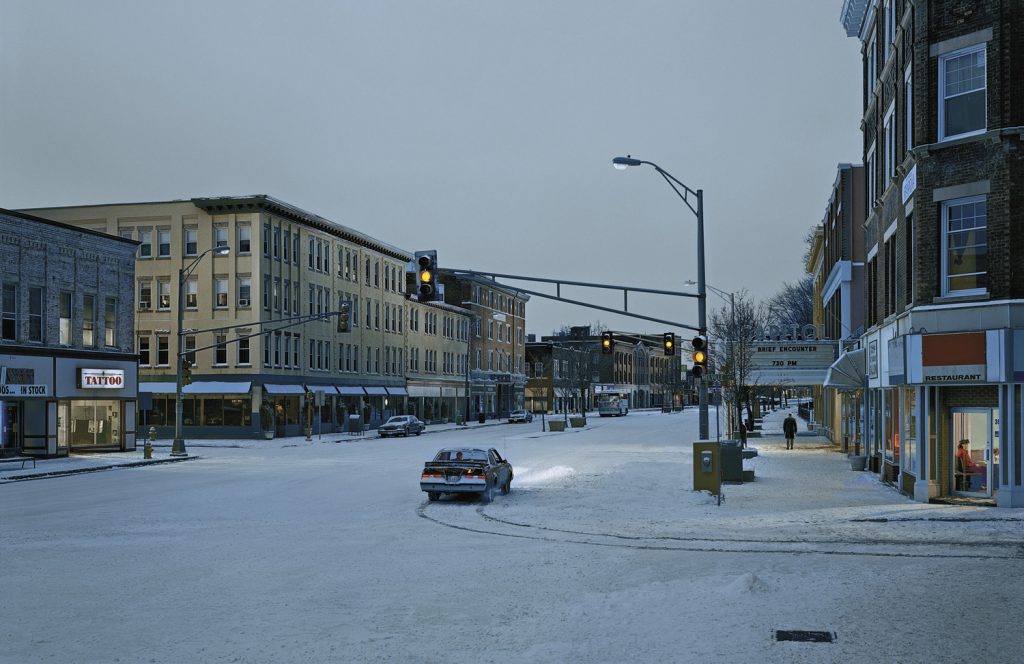
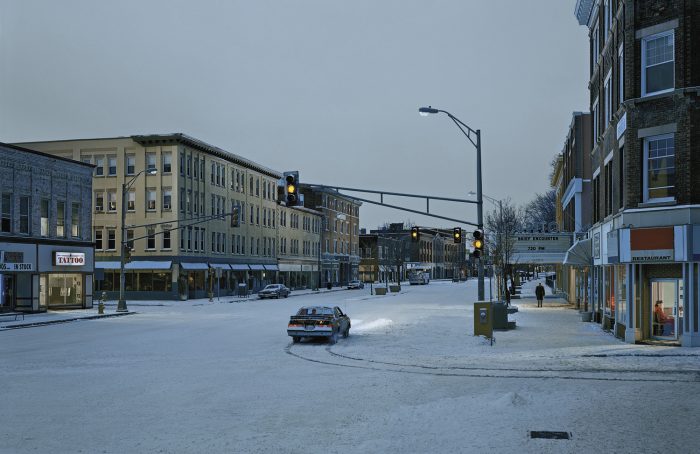
I have chosen three constructed images that particularly interest me. All are fictional scenes, some based on a fictional event in a real world place, Crewdsons Brief Encounters image, one wholly fictional being constructed from disparate elements, Marsoliers Playground 3 and one a little in between., Jeff Walls Sudden Gust Of Wind which is based on a woodcut by the Japanese artist Hokusai and uses real world and digitally manipulated objects to create the scene.
Crewdons and Walls work both use staged events to create a narrative. Crewdsosn use of the Motion Picture style lighting, the largely empty street except one solitary figure and the car tyre tracks combine to give a sense of the Uncanny. Sigmund Freud in his theory specifically relates an aspect of the Uncanny derived from German the German adjective unheimlich with its base word heimlich meaning “concealed, hidden, in secret”. He goes on to identify uncanny effects that result from instances of “repetition of the same thing,” He includes incidents wherein one becomes lost and accidentally retraces one’s steps or instances where random numbers recur.
Crewdsons work successfully exploits the feelings generated by hinting of secret events, either just about to happen or the aftermath of, in this case the twilight, the movement of the car, the only thing moving, crossing the amber light gives the car purpose. Where is it going, is it anything to do wit the lone figure? Is it leaving the scene of something out of frame. We will never know. Despite its motion picture qualities it is of course a still image and Crewdson says that, “My hope is my pictures, although elaborately staged, convey an experience that is intensely real. While my work process is similar to film production, the final result is quite different. Photography limits the narrative to be evoked through one solitary moment.”
He goes on to describe this process as “evoking” where the viewer is left to fill in the gaps, to evoke the narrative which may be influenced by events and experience that have nothing directly to do with the image.
This is very much the method I wish to employ in my own images, although my narative may not be as overt or theatrical as Crewdsons I till need the viewer to ‘evoke’ the circumstances of how my scene came to be or where it is.
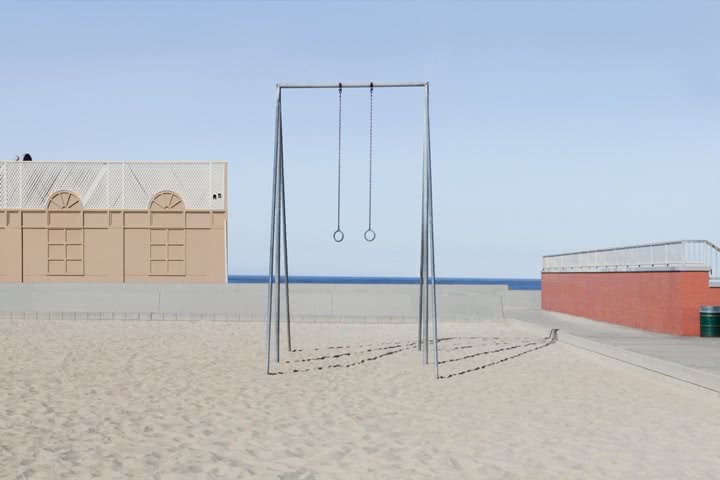
From this point of view my work is similar to Lauren Marsoliers. In her Transition series she creates landscape and urbanscape that are wholly fictional, constructed from real world elements to create a whole ‘new’ and very convincing place. Devoid of population there is a slight sense of uncanny but not in an ominous way. The images do not feel threatening, the lack of people doesnt seem to suggest a calamity, the images are clean, upbeat in some respects, it feels like a virgin environment on some levels but then there are signs that humans have been, maybe are there, some work in progress, a car under its cover tells the viewer people exist or existed.
While Lauren Marsolier’s work is photographic, her process is similar to painting. “Months or years often separate the capture of elements juxtaposed in my landscapes,” she explains. “This approach reminds me of many painters who would make sketches at different locations to use as reference for their future paintings.”
Akin to the way a painter would use his sketchbook, Marsolier uses this library of farmed imagery to construct her tableau landscapes which is very much the method I am employing in my Inbetween Places project.
Where my project is different to Marsoliers is mine does not wish to divorce the captured elements from its original identity, moreover its essential that the places collected remain recognisable or capable of recognition given clues in the caption, maybe GPS or Google Earth co ordinates. Marsolier’s work intentionally blurs the boundary between real and imagined. This is her intention: “I wanted the work to explore tensions between what feels familiar, natural, and what feels alien or fabricated”,
The artificial landscapes she constructs are designed to be confusing, by challenging the viewer’s notion of what is real, my manufactured landscapes also aim to confuse the viewer by moving recognisable places somewhere else.
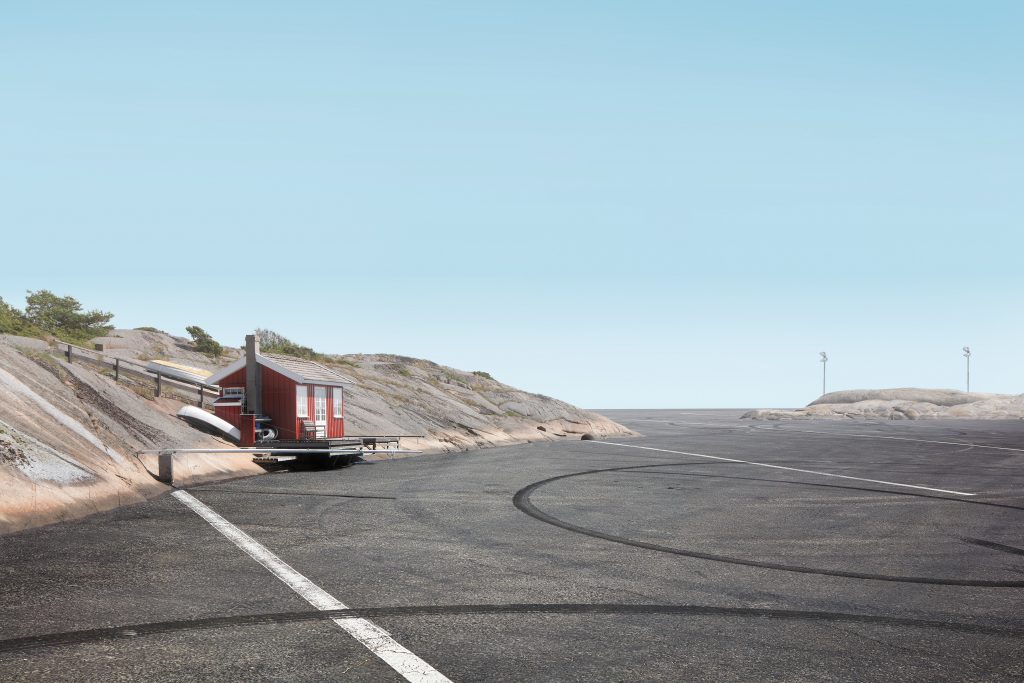
Aesthetically my work is much closer to Marsoliers than Crewdson but the same theories are in play, a scene is created to allow invite the viewer to envoke the story. To imagine whats about to happen, why this classical Norwegian Fjord house appears to be built over a car park. In this case what happened to the water? My images (so far) also exist without people, I have contemplated including them but then I move to a slightly different potential reading where the viewer may start looking at the figures rather than the place.
My intention was to question peoples views of their identity based on the fixed geography of their nation state. If people were included I think they would need to be dead pan but without the drama of Crewdsons iagery.
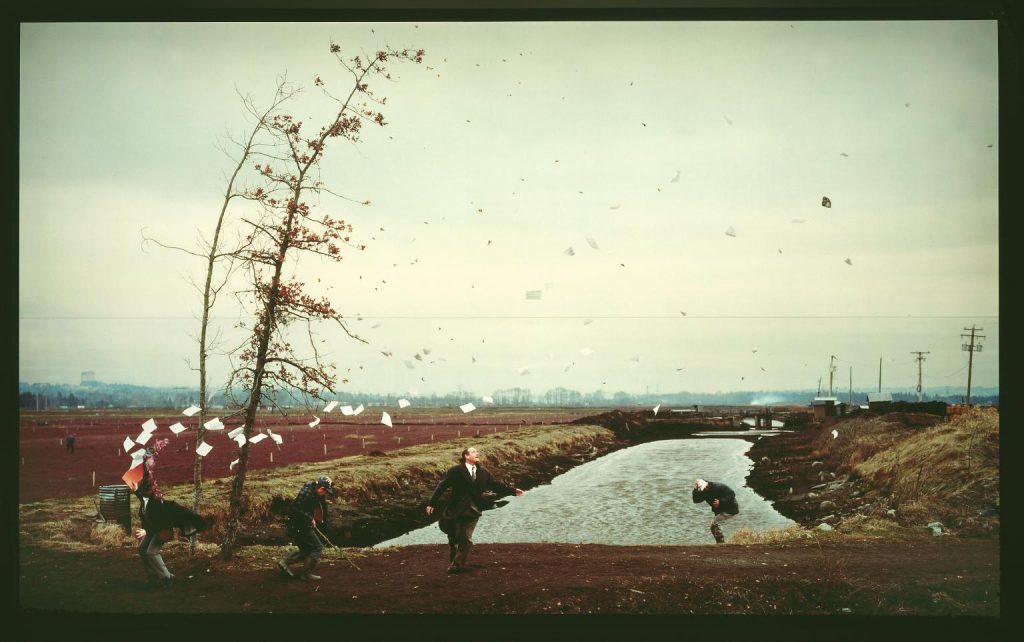
A Sudden Gust of Wind (after Hokusai) is based on a woodcut, Travellers Caught in a Sudden breeze at Ejiri(c.1832) The Thirty-six Views of Fuji, by the Japanese painter and printmaker Katsushika Hokusai (1760-1849).
Wall photographed actors in a landscape located outside his home town, Vancouver, at times when similar weather conditions prevailed over a period of some months digitally compositing the elements.
As in Hokusai’s original, two men hold onto their hats while a third stares up into the sky, where his blows away. Papers blow from a folder, trees bend in the strong wind also shedding their leaves.
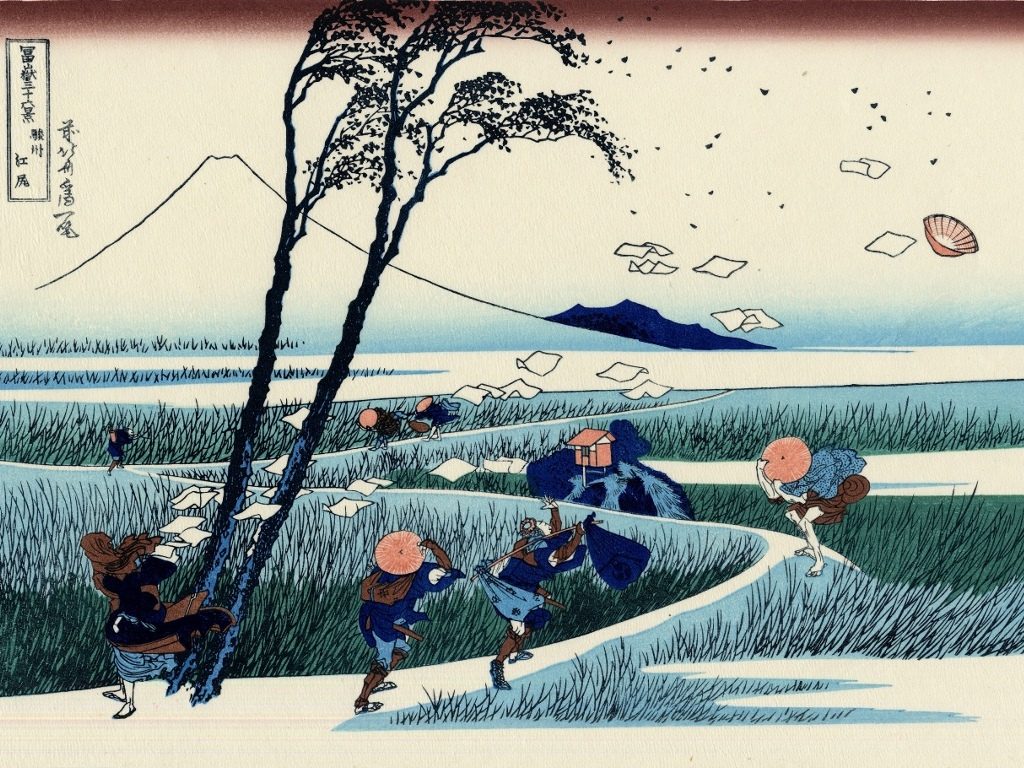
The original woodcut shows a winding path through some reeds leading towards Mount Fuji. Wall’s version is far more agri/industrial. Ploughed fields, telegraph poles and scarred landscape
There is no obvious reason for the characters to be there, why are they dressed in suits, what was their purpose, where is their car? I assume they travelled from the city and not resident in this landscape. What is the purpose of the paperwork?
Whats going to happen next? Assuming the papers are important but now lost..
I like the scaling of Walls work, he resists to fill the frame with the ‘action’ thus the people become part of the scene, very much like people depicted in a classical painting by Constable for instance. I like how he has stayed true to the woodcut yet still creates an image that stands in its own right.
References
Else Barents, Jeff Wall: Transparencies, Munich 1986
www.zoowithoutanimals.com/2014/01/28/a-sudden-gust-of-wind/
https://en.wikipedia.org/wiki/Uncanny#Related_theories
Batchen G, Each Wild Idea: Writing, Photography, History MIT Press, 2002
www.ignant.com/2018/11/27/transition-to-a-fragmented-world-through-lauren-marsoliers-layered-photographs/