I have found this segment very interesting, again as a journey of discovery it has been great to consider other art forms and how they have inspired or affected my own practice and other photographers. I’m still reading through everyones notes but its been exciting to see inspiration from the classics, cinema and game design.
Looking at photographers I like I have been reminded of the work of Ed Ruscha, he is a particularly interesting photographer/artist as he works in number of ways, lens based and also drawing and painting. His photographic work I was drawn to immediately, here is one of his images from his 26 Gasoline Stations mini book from 1962.
Ed Ruscha Philips 66 Flagstaff
Phillips 66 Flagstaff Arizona. taken 1962
What I liked about his approach and description is he doesnt describe himself as a photographer in the context of these images or the images themselves as works of art per se, he just shot what was there and didnt always get the camera level. Interesting to note that he struggled to sell his self published books for $3 at the time, now we would be looking at £10’000 for a decent copy of 26 Gasoline Stations!
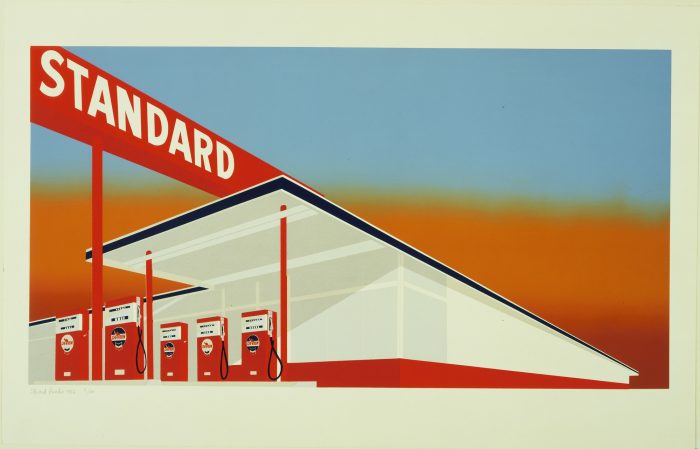
Where it gets interesting is when Ruscha starts to paint scenes inspired by these gas stations and the LA cityscape around him.
This painting I absolutely love, Standard 66, so clean, the sharp lines of the structure overlaid on what I presume is an airbrushed background which is also interesting because at this time most automobile advertising material consisted of airbrushed cars. Interesting that the term ‘air brushing’ is still very much in use to describe digital retouching of images, predominantly in beauty but also colloquially.
I wondered where Ruscha might have been getting his inspiration, we tend to think of he New Topographists as being largely responsible for the recording of the banal as a form of photographic art and thats probably true from a photographic point of view but Edward Hopper was doing this way back in the 40’s and 50’s.
This image, rarely seen ‘Gas’ produced in 1940 reminds me of Ruschas gas stations.
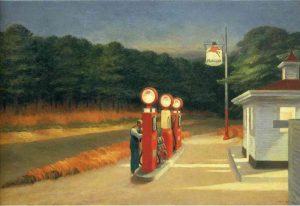
Ok it has a person in it but the view point is standard, mid height, neither heroic nor diminished, it is what it is. Just as Ruscha has done and Shore and Sternfeld after him. The subject matter raised eyebrows for Ruscha, I imagine the audience reaction to this in 1940 would have been one of bemusement, why go to all that trouble to paint a gas station?
Another Ed Hopper painting I feel is hugely influential in the way we approach the built environment today is this 1953 work Office In A Small City.

The composition is tight, the view of the city is largely obstructed by the slab of the building the subject gazes from. This feels very photographic, almost as if shot on a medium telephoto lens as we have a compression of depth that is very photographic in nature.
So maybe Ruscha was inspired by Ed Hopper maybe not but I feel the connection is there and also the way Ruscha turns his own photographic viewpoint into painting form and what information he retains from an actual scene is carefully curated much as Hopper did in his room views.
The image I would like to share is one at least partially inspired by the 26 Gas Stations project and LA city paintings. This image taken at Amboy, California and draws on the banality of a functional structure but I purposefully chose the side of the sign with the most decay, I love how its slowly fragmenting and I love the colours. I completely identify with colourways of Hoppers cityscapes and Ruschas paintings.