
“I suspect no landscape, vernacular or otherwise, can be comprehended unless we perceive it as an organization of space; unless we ask ourselves who owns or uses the spaces, how they were created and how they change. J.B. Jackson
Ive used this quote a few times throughout the course, not because I think it looks good but because it genuinely resonates with me and chimes with my project exactly.
As I have careered around the boundaries, often way beyond in retrospect, of my project Ive found it essential to revisit my practice and what I think it is more often than I ever felt I would. I knew my practice revolves around humanity. This was a conclusion thats slowly dawned on me and became clearer, my time in hospital although on the face of it was a great time to be able to devote thought and gain clarity did nothing of the sort and my anxiety led me down many dark paths that I almost regret.
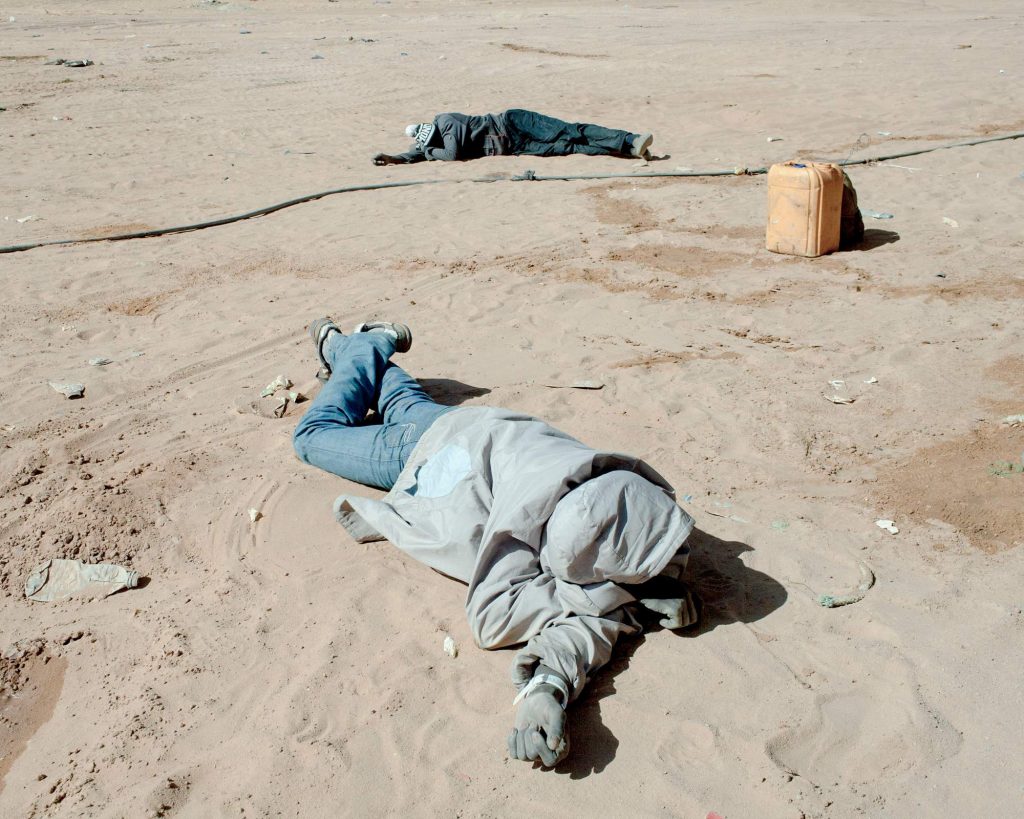
Associated Press, deceased migrants Libya
When the images you work with look like the above you know that your mind has travelled into much darker spaces and had I not been in such a precarious state with my own health I doubted I would have gone there. However maybe you have to go there to be able to come back better informed.
I used to think I shot many different subjects which is true to an extent but looking at them with a more informed eye I can now see it was always he human element that is the consistent feature. Landscape in particular there will be inevitable traces of human activity in one way or another.
Taking take the privilege of the unseen observer, the image of the beach above I suppose could be considered voyeuristic but I wasnt hiding via use of long lens or digital technology, i’m using a standard lens and stood in plain site but unseen to the subjects as they are very absorbed in their ‘photo session’ continued for a good ten minutes, were the poses a tacit invitation for all to record? So my gaze falls on the world where humans inhabit or have made their inevitable marks.
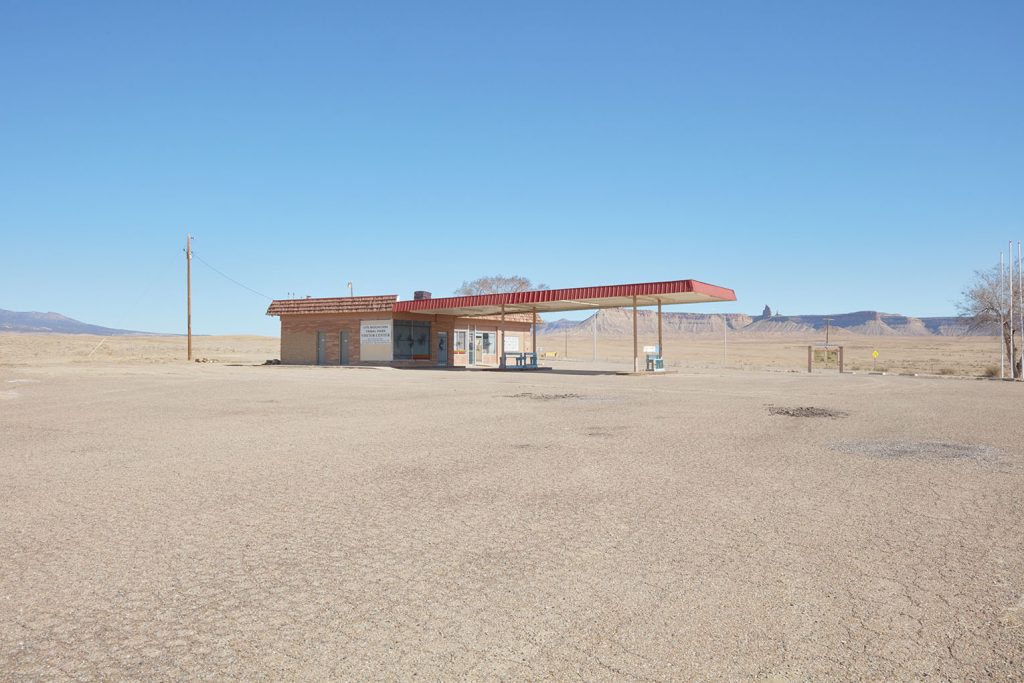
Thus my view on the world is influenced by the changes humans have made to it, I rarely if ever photograph purely natural things.
My own ‘style’ or ‘look’ I would describe as observational. Im looking for themes, often making comments that I hope my audience will spot and investigate further. I do use compositional rules to help the viewer find their way around the images. In many cases following my directions will lead to a questioning of what it is exactly the viewer is looking at and my theme or comment that may not have been immediately obvious to them might merge.
“Photographs of a Man-Altered Landscape” was how Jenkins had identified in the work of US photographers Robert Adams, Lewis Baltz, Bernd and Hilla Becher (hurrah, a woman!), Joe Deal, Frank Gohlke, Nicholas Nixon, John Schott, Stephen Shore, and Henry Wessel, Jr. This is very much what I am also concerned with, the man altered landscape.
Sean O’Hagen in his piece in the Guardian, New Topographics: Photographs that find beauty in the banal observes
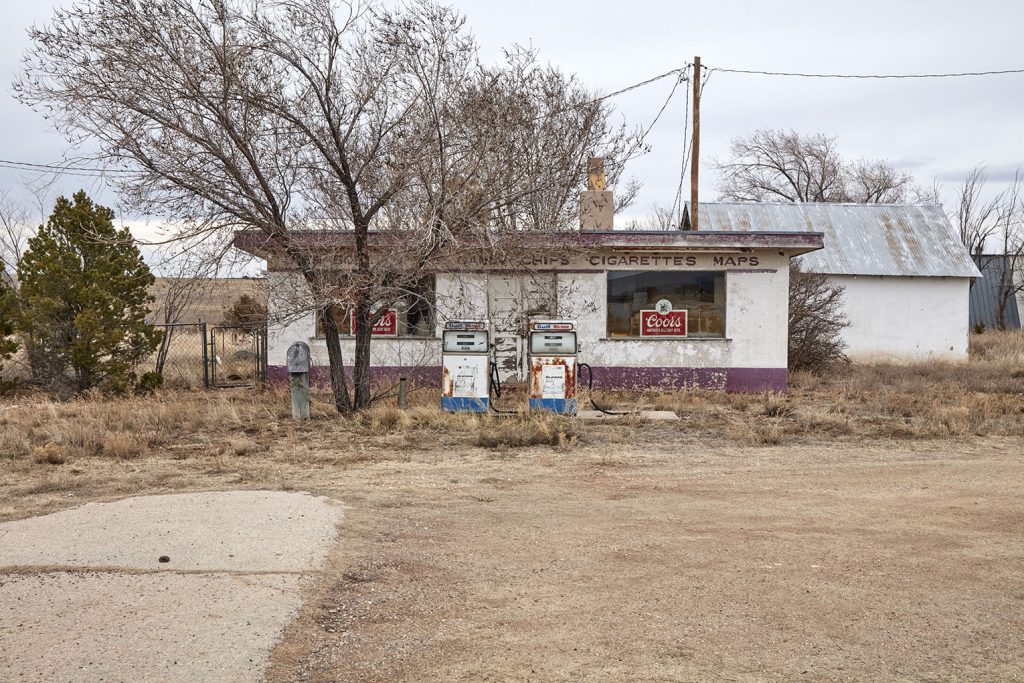
“Only one photographer, Shore, shot in colour. It seemed to heighten the sense of detachment in his photographs of anonymous intersections and streets. Shore was influenced by Ed Ruscha, the conceptualist of Californian cool, who, in the 60s, had made a series of artist’s books with self-explanatory titles such as Twentysix Gasoline Stations, Some Los Angeles Apartments, Every Building on the Sunset Strip. The show also nodded obliquely at the later work of Walker Evans, who had photographed the vernacular iconography of America in road signs, billboards, motels and shop fronts”
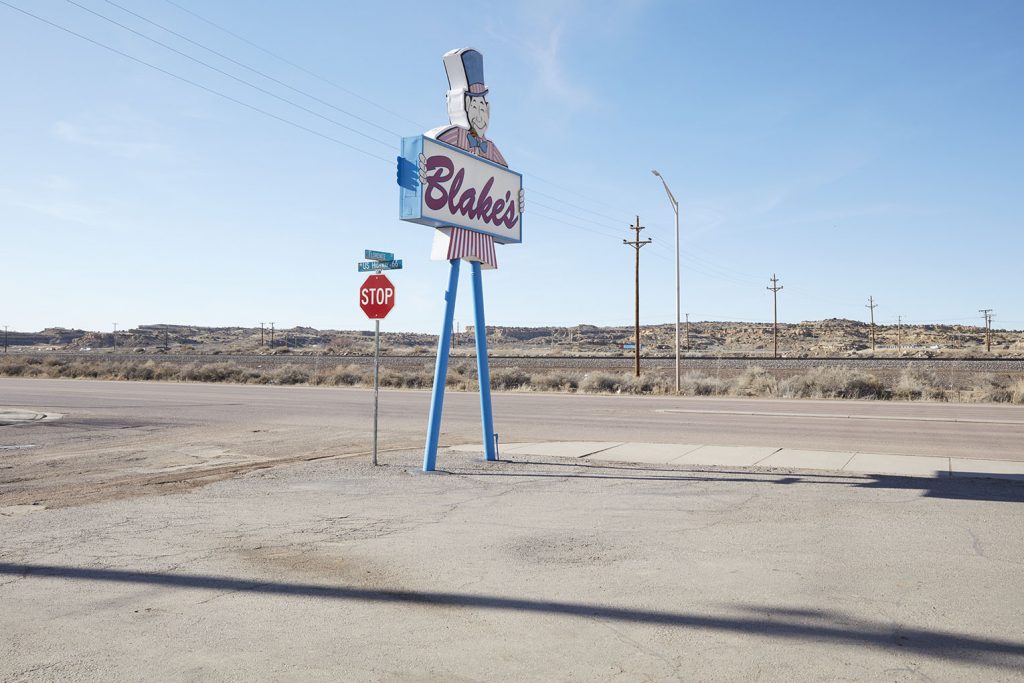
Although I also choose to photograph the vernacular and banal, I do not pursue my subjects in the same way as Ruscha shot his gas stations, he shot them as they were. A “they are what they are” approach. See my post last week about Ruscha. I choose my subjects with a point in mind. The image above, shot near Hisperia CA is the a gigantic recently cleared plot on the new edge of town. Clearly Main Street isn’t what it was. Maybe this phase is transient but the collapse of small town America is no secret and I fear the lot will remain as it is.
Andy Grundberg has noted,
“For all its virtues in making us engage photographs more closely and complexly, the aesthetic of the equivalent…has one major shortcoming: after asserting that an apparently transparent image of the world is imbued with individual vision or feeling, it has difficulty defining what that vision or feeling is. Used as a critical instrument, the theory of equivalence is unable to determine any intended meaning in a photograph. But as a credo, it has served as the dominant aesthetic of American photographic modernist practice.”
As a photographer whose practice has evolved without the benefit of an arts based education or any real appreciation of the world of art photography until quite recently in real terms every discovery sheds new light on my practice and its incredibally exciting to discover what motivated Shore, Balts, Adams etc also motivated me before I was formally aware of their work beyond a superficial level and certainly their motivations for producing it.
To me it proves that the need to record, make sense of the world around us, the landscape according to your vision is an inbuilt trait, an obsession or need that we have to express.
Jenkins speaking of the photographers in New Topographics claims that although their photographs convey “substantial amounts of visual information,” they are, above all, aesthetic arrangements resisting interpretation. He quotes Robert Adams:
“By Interstate 70: a dog skeleton, a vacuum cleaner, TV dinners, a doll, a pie, rolls of carpet…Later, next to the South Platte River: algae, broken concrete, jet contrails, the smell of crude oil…What I hope to document, though not at the expense of surface detail, is the Form that underlines this apparent chaos”.
Deborah Bright says “If we are to make photographs that raise questions or make statements about what is both in and around the picture, we must first become more conscious of the ideological assumptions that structure our approaches”. This interests me and resonates, my first aim when embarking upon this MA was to understand my own practice and then be able to articulate that vision. Also as part of my journey and evolving desire to create works for gallery display this next statement concerns me.
“As part of this, we need to examine the restrictive terms of the art museum and gallery nexus and ask ourselves whether we need to seek out other markets and audiences for our work”
This is something I never really considered, as I make my own art, playing by my rules and personal motivations will it ‘fit’ into the gallery nexus, will I need to discover my own outlet?
As Lewis Baltz says “The landscape…seems more a set of conditions, a location where things and events might transpire rather than a given thing or event in itself; an arena or circumstance within which an open set of possibilities might be induced to play themselves out”
References:
J.B. Jackson, “Concluding with Landscape,” Discovering the Vernacular Landscape (New Haven: Yale University Press, 1984), p. 150.
D Bright Of Mother Nature and Marlboro Men An Inquiry Into the Cultural Meanings of Landscape Photography
www.theguardian.com/artanddesign/2010/feb/08/new-topographics-photographs-american-landscapes
http://www.hyperallergic.com/417634/walker-evanss-eye-on-the-city/
Andy Grundberg, “Ansel Adams: the Politics of Natural Space,” The New Criterion (November 1984), p. 150.
Lewis Baltz, “Landscape Problems,” Aperture 98 (Spring 1985).